中文简体
 中文繁体
 English


Virtual Currency Wallet & Digital Wallet White-Label Setup | Multi-Chain Wallet One-Stop Delivery 2
Getting Started with Blockchain Digital Wallets: From Private Keys to Asset Self-Custody, What Ordinary People Really Need to Understand
More and more people hold cryptocurrency, but few truly understand "how to keep it safely in your own hands." Almost every few days, the same plea appears in communities: the crypto is still at the address, but the wallet won't open; one letter of the mnemonic was copied wrong; after switching phones, you realize you never made a backup. These losses aren't because the technology is complex — it's because most people, before actually holding crypto, never seriously understood what a "wallet" really is.
This article doesn't discuss market prices — only the wallet itself: what it holds, why losing it means you can't get in, what counts as a real backup, and what to look for when choosing one. Understanding these few things is more valuable than learning ten trading tricks.
I. What's in a Wallet Isn't Crypto — It's Keys
One of the most common misconceptions is that crypto is stored in the wallet. That's not true. Crypto is always recorded on the public chain; not a single coin has ever been stored in the wallet. What the wallet really manages is a set of keys — it lets you exercise control over the crypto at the address.
This distinction determines a lot. First, uninstalling the wallet app, losing your phone, or the service provider going out of business will not make your crypto disappear, because it was never in those places. Second, conversely, if the private key is lost — even if the wallet app is still installed and the provider is still operating normally — no one can return the crypto to you, because there is no second key.
This is also the most fundamental difference between a wallet and a bank card. A bank card is issued by a bank: forget the password, you can reset it at the counter with your ID; lose the card, you can report it lost and freeze it; if the account is compromised, you can request a rollback. A wallet that manages crypto has no such fallback: no central authority, no human customer service, no lost-card process. The rules are written in cryptography, not in terms of service.
II. Six Terms Make Up the Whole Wallet
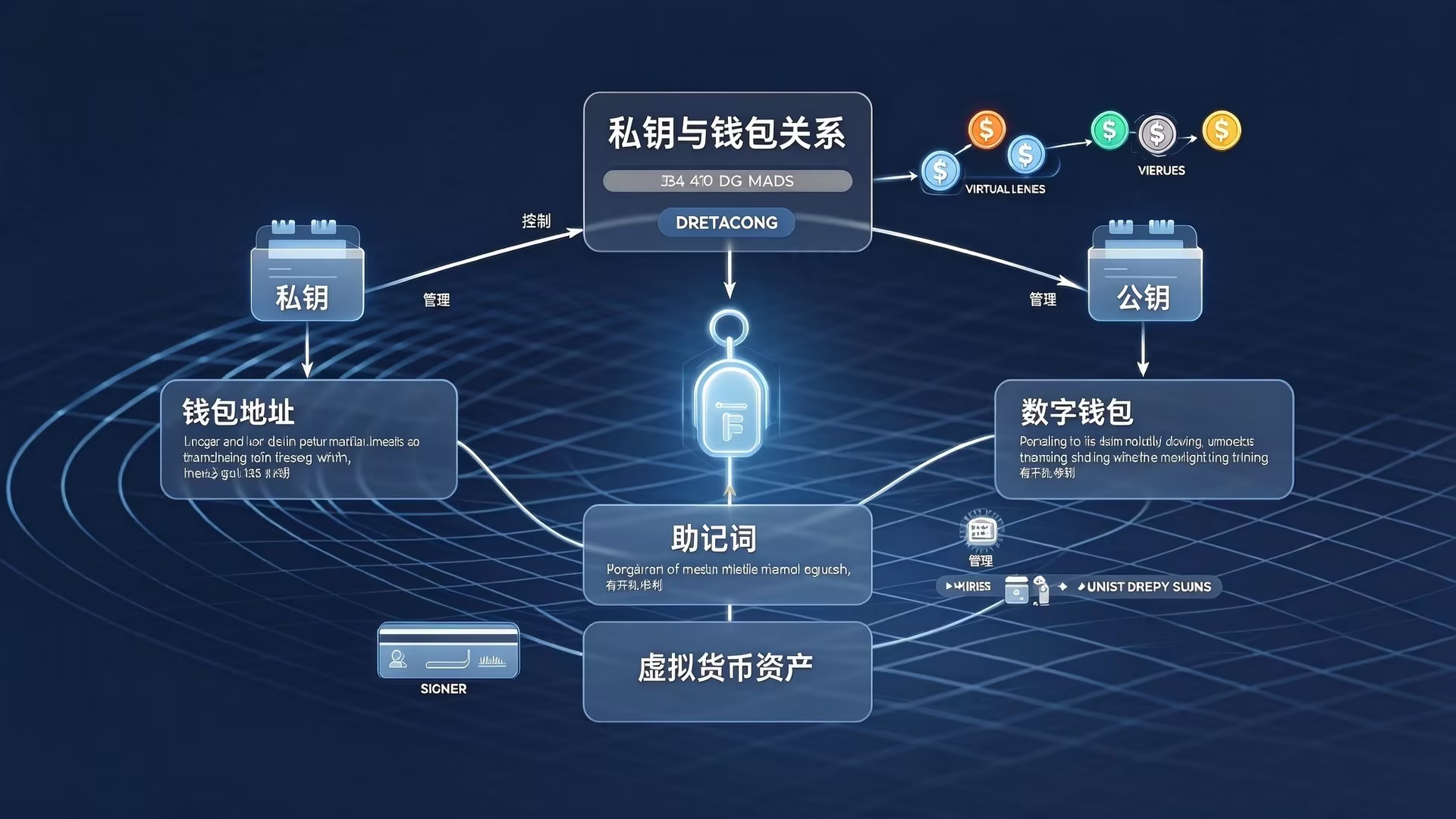
To understand a wallet, you only need to clarify the relationship between six terms.
Private key: a string of numbers and letters generated by a random algorithm, typically a 64-character hexadecimal string. It represents your complete control over the crypto at the address — whoever has it effectively has the wallet.
Public key: derived from the private key via elliptic curve cryptography. Its role is "something you can show others" — others use the public key to send you crypto, but cannot reverse-engineer your private key from it.
Address: a shortened version of the public key after hashing — the string you normally send to others to receive payment. Address and public key are interconvertible, but the two steps from private key to public key and public key to address are one-way.
Mnemonic phrase: converts the private key into an ordered set of common words, easy to write down and remember. It is essentially another form of the private key, with security equal to the plaintext private key — whoever has the mnemonic has the wallet.
Keystore: a file generated by encrypting the private key, requiring your chosen password to use. Its value: even if the file is stolen, the attacker still has to crack the password, and that window of time is enough for you to move the crypto elsewhere.
Password: merely the lock that opens the Keystore; by itself it cannot recover the wallet. Forget the password and have no mnemonic, and you have completely lost access.
In one sentence: private key equals Keystore plus password; the mnemonic is also the private key; the public key is for receiving; the address is for display. Understand this layer, and all the security advice that follows is just a corollary.
III. Wallets Can Be Classified Along Multiple Dimensions
By private key custody: self-custody and custodial. With a self-custody wallet, the private key is in your hands and every transaction you sign is initiated by you; with a custodial wallet, the private key is held by the platform and what you see is a number on the platform's ledger. The former is free but the responsibility is entirely yours; the latter is worry-free but depends on the counterparty's credit.
By connectivity: cold wallets and hot wallets. A cold wallet keeps the private key completely offline — e.g., a hardware device or paper backup; a hot wallet keeps the private key in a connected environment — e.g., a mobile app, browser extension, or online wallet. Cold is more secure but cumbersome; hot is more convenient but more exposed. A common practice: keep large, long-term holdings in cold storage and use hot for daily small interactions.
By on-chain/off-chain: on-chain wallets and off-chain wallets. Every transfer in an on-chain wallet is broadcast to the public chain and packaged into a block — verifiable, auditable, and irreversible; off-chain wallet transactions occur only on the platform's internal ledger — faster, but you don't actually hold the private key.
By data completeness: full node wallets and light wallets. A full node syncs the entire chain's data — large footprint, slow startup, but the most complete verification; a light wallet stores only data related to you — small, quick to get started, and the choice of the vast majority of users.
By signing mechanism: single-signature and multi-signature wallets. Multi-sig requires several keys to sign together before a transaction can complete — suited to team treasuries, family co-management, project funds, and similar scenarios, using process to compensate for single-point mistakes.
IV. Security Sense Comes from Four Mathematical Facts
A wallet's security doesn't come from the shield icon in the interface — it comes from four things.
First, random numbers. Private keys are generated from random numbers, which must be random, unpredictable, and non-reproducible. Poor randomness means the key could be brute-forced or hit by credential stuffing — which is why you should never use a "pattern number" you thought up yourself as a private key.
Second, asymmetric encryption. Encrypt with the public key, decrypt with the private key; the two correspond one-to-one and cannot be derived from each other. Even if intercepted in transit, an attacker with the public key cannot decipher the content.
Third, one-way hash functions. An input of any length produces a fixed-length output, and the process is irreversible. Addresses are hashed from public keys — precisely because of this, publishing an address reveals nothing about the private key.
Fourth, the one-way nature of elliptic curves. The private key can derive the public key, but the public key cannot derive the private key. This one-way step is the prerequisite that makes the entire self-custody system possible — you can paste your address anywhere, as long as the private key never leaves.
V. Why Lost Really Means Lost
Some ask: can the wallet provider help me recover it? The answer is: technically impossible, and institutionally not allowed.
First, wallet providers don't store your private key. The design principle of the vast majority of wallets is "never touch user keys"; the server holds only your encrypted public information. It has no ability to recover for you, nor to freeze for you.
Second, public chain transactions are irreversible. Once an address is entered wrong or an amount is sent, the on-chain record is final — there is no rollback mechanism. This is completely different from a bank transfer that can be reversed.
Third, public chains are anonymous. You can see the flow between addresses, but not who is behind them. This means that even if the crypto is transferred away, you cannot pursue it through identity information — your only recourse is offline channels.
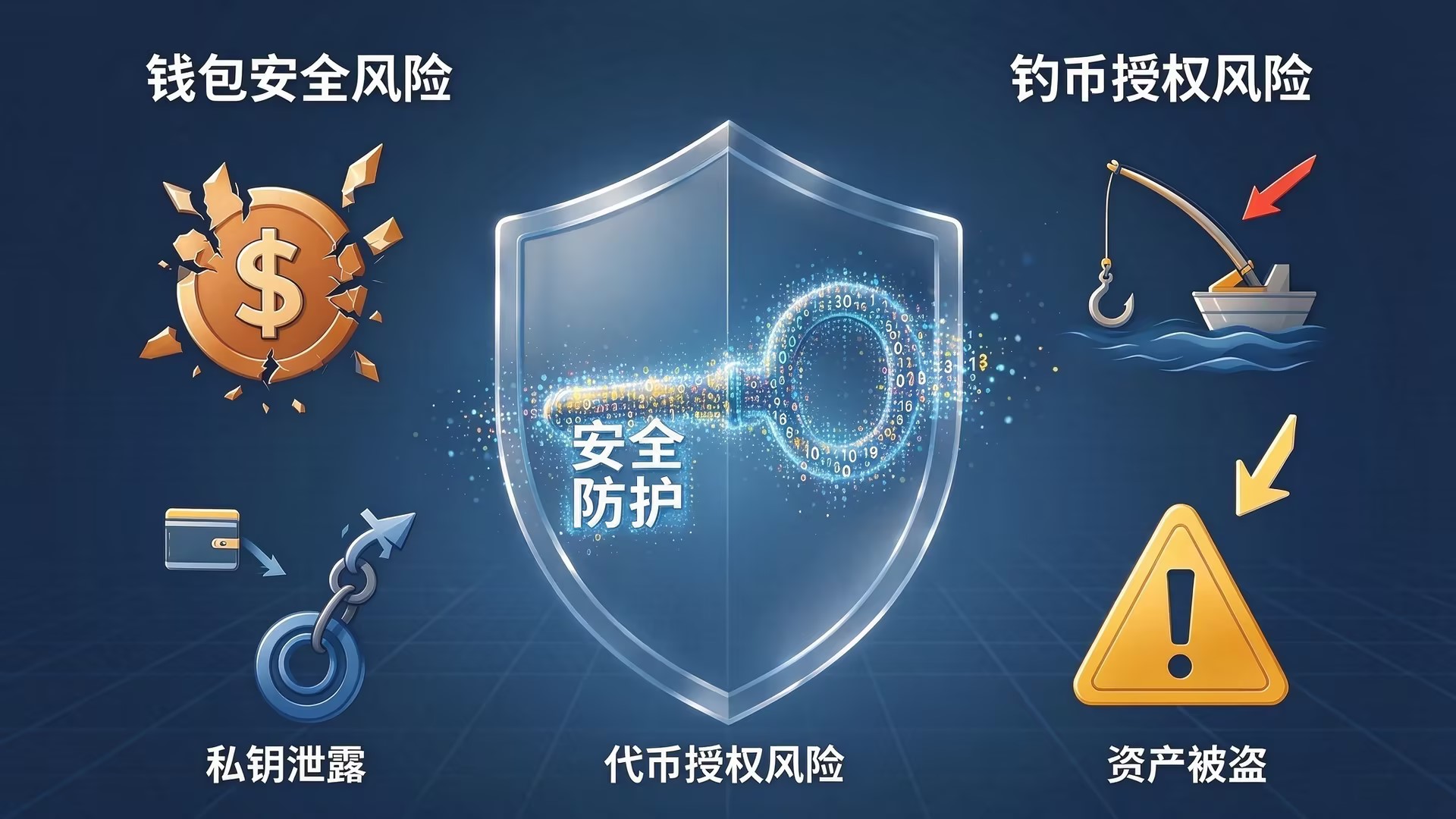
Put these three together, and the conclusion is clear: in the world of self-custody, security responsibility falls almost 100% on the single act of "keeping the private key safe."
VI. Backup: Writing It Down Isn't a Successful Backup
Backup is the most underestimated step. A truly effective backup consists of three actions, none of which can be omitted.
Redundant backup. Keep one copy each of the Keystore and the mnemonic. The Keystore is an encrypted file, best stored on an offline USB drive, and must be kept separately from the password; the mnemonic has no encryption protection at all, so it must use a physical medium — written on paper, with clear, long-lasting legibility.
Second, cross-verification. Immediately after writing it down, verify in reverse: re-import the mnemonic into the wallet and check whether the generated address matches the original. An unverified backup is no backup — one wrong letter or one missing word is extremely hard to notice later.
Third, off-site storage. Store the same backup in two places to avoid total loss from fire, flooding, or theft. Don't take photos, don't take screenshots, and don't save it in chat history or cloud notes — those are exactly the high-risk areas for leaks.
Password management also needs separate treatment. The Keystore password should be strong, random, and not reused across accounts, and stored in a password manager. Many people set a strong password but write it on a sticky note — bringing security back to zero.
VII. The Most Common "Won't Open" Scenarios
Scenario 1: After importing the mnemonic, the address doesn't match. First check whether the backup was copied wrong — especially easy to confuse when managing multiple addresses; then check word order and spelling; finally cross-import with another wallet to determine whether it's a backup problem or a software problem.
Scenario 2: Forgot the Keystore password. With the mnemonic, re-import and set a new password — and remember to back up again; without the mnemonic, you can only rack your brain — no institution can offer recovery.
Scenario 3: Switching devices or reinstalling the app. With the mnemonic or Keystore plus password, you can fully recover; with neither, you must accept the loss.
Scenario 4: Suspecting the private key has leaked. Immediately transfer the crypto to a newly generated wallet address and stop using the old one; also check the device for trojans to avoid the new key leaking too.
Scenario 5: Deleting the wallet without a backup. This is the most regrettable kind of loss, often happening at the "just trying it out" stage. The habit to build: the first thing after creating a wallet is to back it up, the second is to verify the backup, and the third is to transfer crypto in.
VIII. Wallets Are Turning from Tools into Gateways
Early wallets did just one thing: store the private key and send transactions, and mostly supported only a single chain. Today's digital wallets are clearly different.
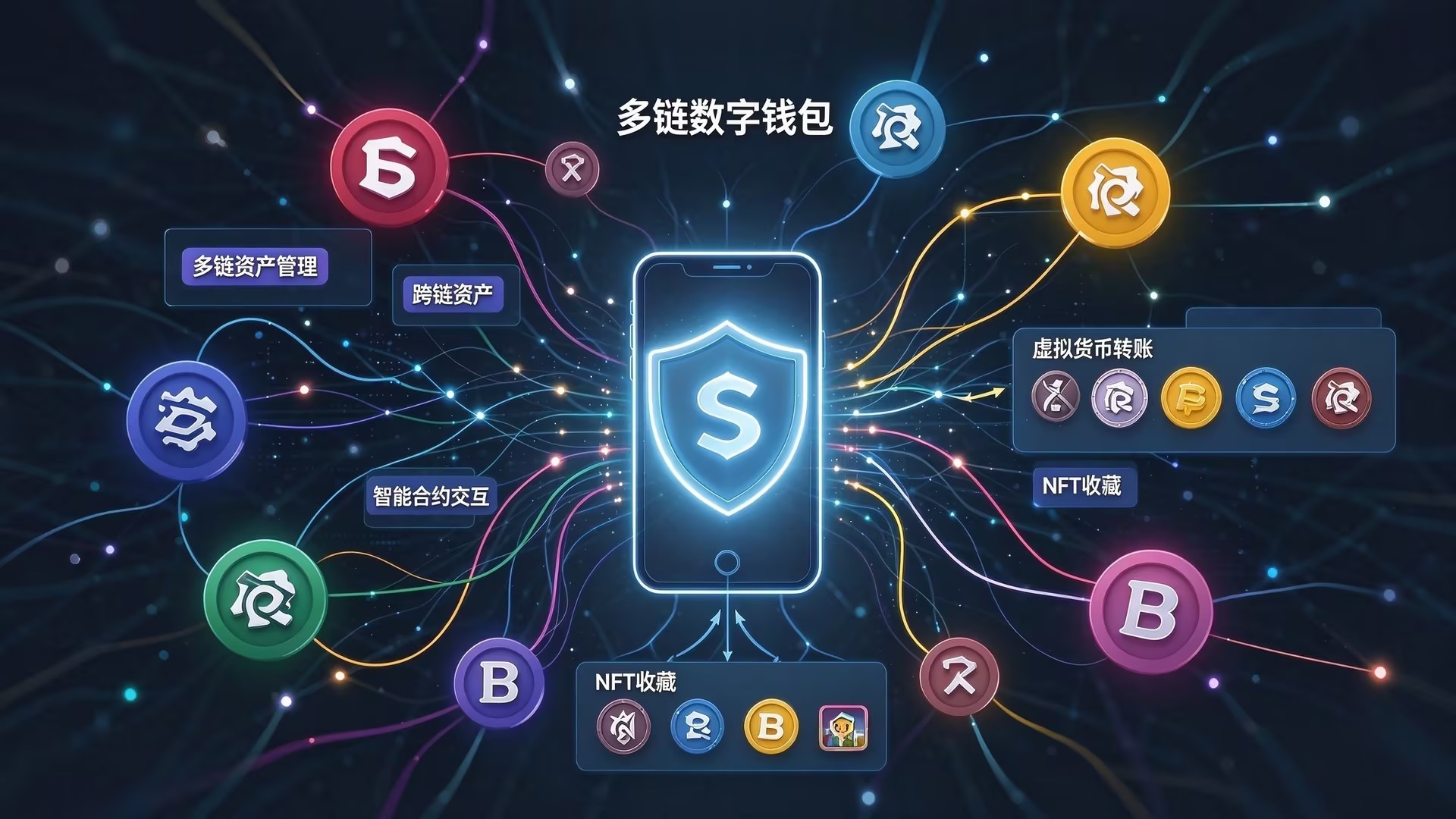
One: multi-chain aggregation. One wallet manages crypto across multiple public chains, so users don't need a separate app for each chain; the on-chain wallet experience is moving toward "one account to see all assets."
Two: account abstraction and social recovery. Users log in with email or social accounts, transactions are executed by smart contract accounts, gas can be sponsored by the provider, and the mnemonic is replaced with a friendlier recovery method. It lowers the barrier, but also shifts part of the security responsibility onto the contract design itself.
Three: multi-party computation and multi-sig custody. By sharding the key, one private key is split into several parts held separately; signing is computed collaboratively, so no single party can move the assets alone. This approach is increasingly common in institutional and team settings.
Four: wallets integrated with scenarios. The wallet is no longer just an entry button, but a comprehensive terminal carrying identity, credentials, membership benefits, and crypto management. For the application side, digital wallet development has gone from "integrating an SDK" to "designing an account system."
IX. What to Look for When Choosing a Wallet
Ignore the marketing slogans; look at five things.
First, whether private key ownership is clear. Self-custody or custodial, and whether the provider can access your keys — this determines the nature of the risk.
Second, whether it's open-source and audited. Wallets with inspectable code and published audit reports are less likely to contain backdoors.
Third, whether backup and recovery paths are clear. Is there guided mandatory backup, is the recovery process smooth, and does it support multi-signature or social recovery?
Fourth, multi-chain support and on-chain interaction capability. Which public chains are supported, whether cross-chain is built in, and whether authorization scope is clearly displayed during interaction.
Fifth, team and operational stability. A wallet is a long-term product; whether the provider can sustain maintenance and respond to emergencies matters more than a temporary abundance of features.
X. Conclusion: Self-Custody Is a Responsibility
The digital wallet is called "the bank card of the future world" because it truly returns control of crypto to the individual. But the other side of rights is responsibility: no customer service to turn to, no lost-card process to reverse it, no law to pursue it. All you can rely on is your own understanding and safekeeping of the private key.
For ordinary users, there are really only three things to remember: there's no crypto in the wallet, only keys; writing it down isn't a successful backup until you've verified it; and once the private key leaks, no institution can save you.
For the product side, the value of a digital wallet isn't just "how many chains it supports" — it's whether you can hide the complex key logic in the backend and put clear responsibility boundaries up front — so that users can safely hold their own crypto without understanding elliptic curves. That's what makes a wallet truly advanced.