中文简体
 中文繁体
 English


Exchange · Public Chain · Cross-Chain Smart Contract DApp Exchange · Public Chain · Cross-Chain Custom Turnkey System Development 2
RWA Platform Custom Development: Why Do Quotes for the Same "RWA" Differ by Tenfold?
Building an RWA platform starts with a reality check: public chain development — which chain to choose, how to design the contracts, and how to align on-chain and off-chain states. This step alone sets the direction for every quote that follows. Many project teams hit the same confusion when requesting quotes: everyone is talking about the same thing — build an RWA platform, digitize real-world assets, attach certificates to the chain through public chain development, and let users hold and transfer them via digital wallets. Yet Company A quotes tens of thousands, Company B quotes hundreds of thousands, and some quote seven figures. Put the quotes side by side, the features look similar, but the numbers seem to come from two different industries.
The issue is not how much a company wants to charge — it's that the phrase "RWA platform" only states a direction, not the scope of work. Public chain development can mean a single-chain standard contract, or it can mean multi-chain deployment and cross-chain mapping. A digital wallet can be just a connection, or a self-built custody system. Same name, tenfold difference in engineering effort — perfectly normal.
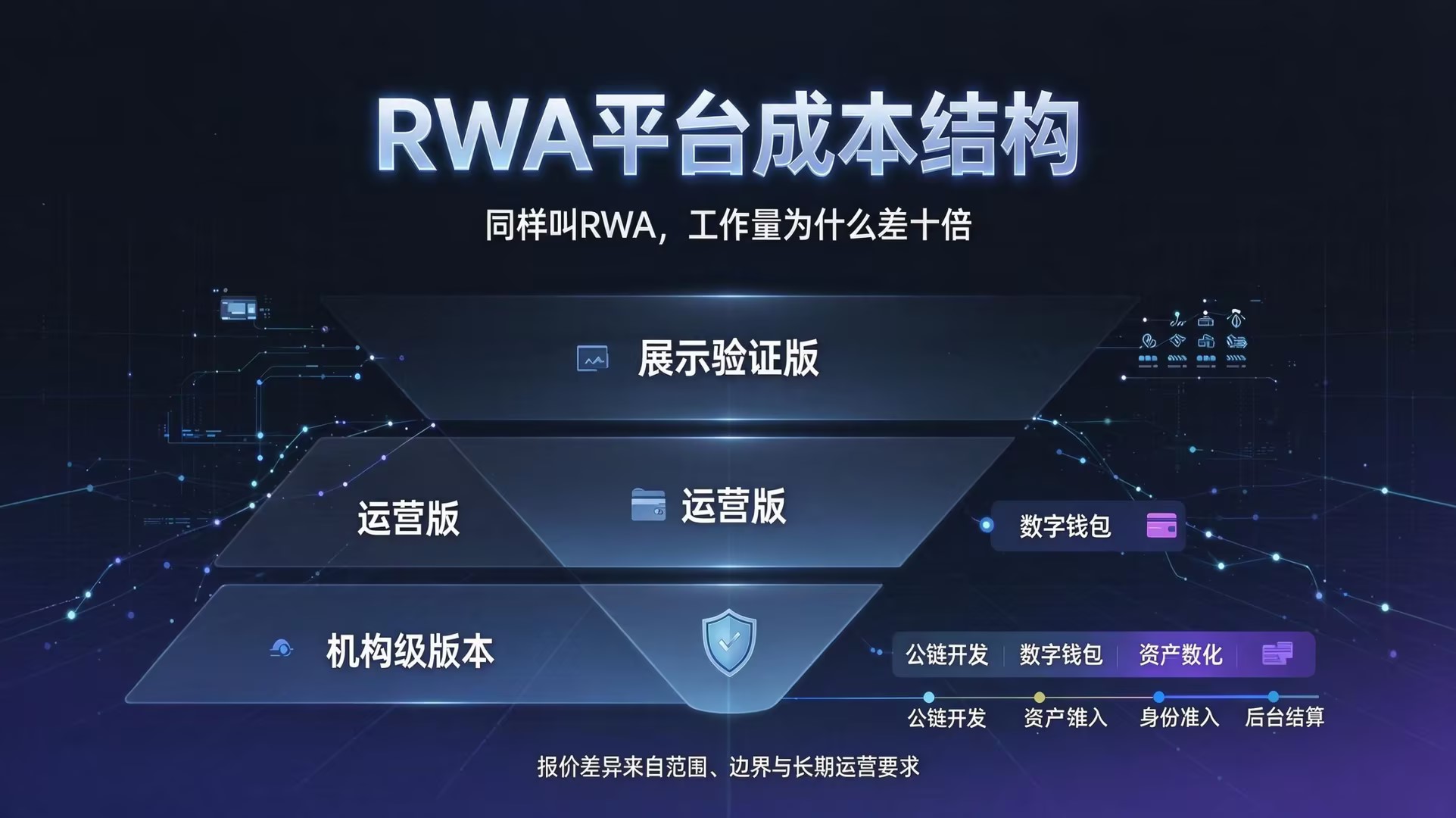
I. First, Distinguish Three Versions to Match the Quote
Version 1: Demo/validation version. The core is to tell the RWA story clearly: what the asset is, how it is valued, how asset digitization works, and how shares are divided. Users can register, view documents, and access their profile; the on-chain wallet is only connected to display holdings. Public chain development usually issues only standard contracts — enough to demo and show partners, but real fund and asset flows remain simulated.
Version 2: Operational version. Users must complete real-name verification, subscription, holding, inquiry, and redemption on the platform. RWA shares need real accounting logic; the digital wallet must actually manage money; every inflow and outflow in the on-chain wallet must be reconcilable by the platform. Public chain development is no longer a one-time delivery — it requires ongoing maintenance of consistency between on-chain state and the platform ledger.
Version 3: Institutional-grade version. This deals with entrusted assets, audit requirements, compliance documentation, and custody arrangements, requiring permission separation, operation logs, disaster recovery, and emergency mechanisms. Public chain development must also consider multi-chain deployment, contract upgradeability, and oracle integration. Its workload is not the sum of the first two — it's an entirely different order of magnitude.
Most failed negotiations come down to this: one side quotes based on Version 1 while the other demands Version 3, and neither clarifies the boundary between public chain development and the digital wallet.
II. Public Chain Development: Underlying Selection Rewrites the Quote
Many assume public chain development is simply "pick a chain, deploy a contract" — it's far more than that. The peculiarity of RWA is that assets must persist over the long term and ownership must remain valid, so public chain development must answer several hard questions up front: which chain, whether multi-chain deployment, whether contracts are upgradeable, what certificate standard defines the digitized asset, and how on-chain events are relayed back to the platform.
If it's a single chain, standard contract, one-time issuance, the workload is manageable. But if it requires multi-chain support, cross-chain asset mapping, on-chain event callbacks, and guaranteed consistency between the platform ledger and on-chain state at all times, public chain development turns from "one module" into "an underlying link that runs through the entire system."
That's why two quotes both saying "includes on-chain" can differ so much: one ends when the contract is deployed; the other requires continuous maintenance of on-chain/off-chain consistency.
III. Digital Wallet vs. On-Chain Wallet: The Most Underestimated Dividing Line
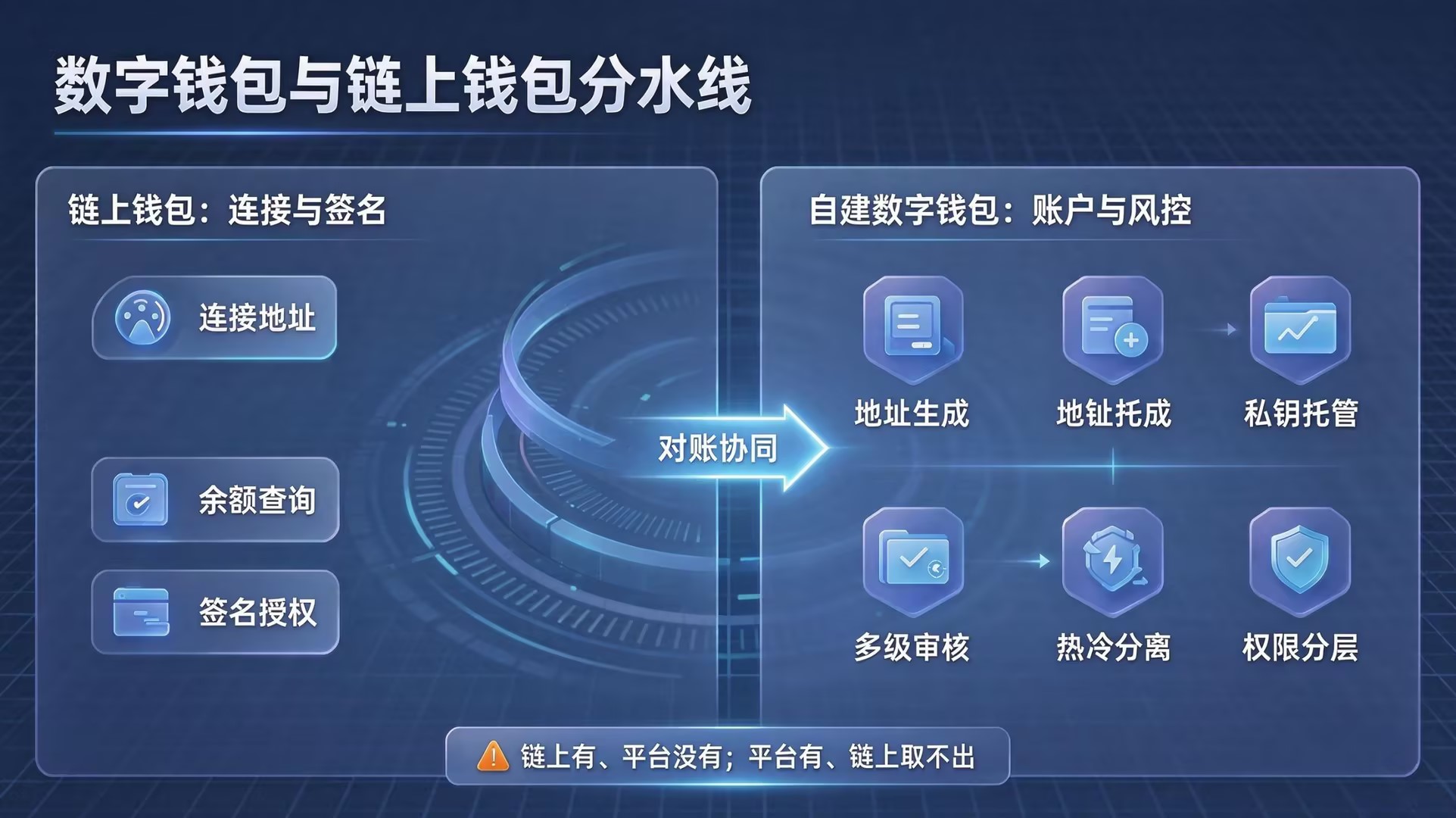
Some platforms only need users to connect an existing on-chain wallet — read the address, check the balance, sign authorization. Cost is low; the digital wallet is just an entry layer.
But once you build "the platform's own digital wallet system," everything changes: how addresses are generated, how private keys are custodied, how assets are pooled, how withdrawals go through multi-level review, how permissions are tiered, how anomalies are frozen, and how operations are logged — each is an independent module. Add limit controls, hot/cold separation, and risk rules, and digital wallet development often exceeds the entire frontend.
More critically, the digital wallet and on-chain wallet must work together: the on-chain wallet handles real asset holding and signing; the digital wallet handles the platform's account system, balance display, and business deductions. If the reconciliation logic is poorly designed, you get awkward situations like "on-chain has it, platform doesn't" or "platform has it, can't withdraw on-chain."
So when a quote says "wallet included," ask: connect an on-chain wallet or build a digital wallet? Display only, or including pooling, review, and reconciliation? The gap between these terms is usually the main source of the price gap.
IV. Asset Digitization: From Physical Assets to On-Chain Certificates, the Work Hides in the Middle
Asset digitization sounds like one line, but it's a whole process. The underlying asset needs descriptions, valuation basis, ownership documents, and change records; the middle layer handles share splitting, additional issuance, buyback, revenue distribution, and maturity processing; the top layer maps to RWA certificate minting, freezing, transfer, and burning.
Of the three layers, public chain development covers the top certificate layer, the digital wallet covers holding and transfer, and what actually eats the schedule is the middle accounting layer: how shares are calculated, how revenue is split, how maturity is handled, how anomalies are rolled back. Done well, users see clear RWA shares; done poorly, the chain is full of certificates but the platform can't figure out who gets what.
V. Identity Access: The Biggest Difference Between RWA and Traditional Digital Assets
Traditional digital assets champion permissionlessness; RWA is the opposite — who can hold, how much, and in which region must all be constrained by rules. This is more than plugging in a real-name API; it involves accredited investor checks, regional restrictions, quota tiers, whitelist management, and access-change auditing.
These rules must be bound to the digital wallet: users at different tiers have different spending limits; users in different regions have different subscription scopes; the on-chain wallet's authorization logic must also change with tier. The finer the rules, the more edge cases the system must handle, and the more the permission controls on the public chain development side must be refined in sync.
VI. Backend and Settlement: Invisible to Users, but Decisive for Cost
Users see barely a dozen screens. But when the platform actually runs, the backend manages far more: project documents, asset ledgers, user profiles, review records, subscription orders, quota occupancy, equity changes, settlement reconciliation, permission settings, operation logs, and anomaly alerts.
Settlement especially. How subscription funds flow in, are recorded, reconciled, and refunded; how fiat channels connect with on-chain channels; how assets received by the on-chain wallet match balances recorded in the digital wallet — all need dedicated modules. They don't appear in homepage screenshots, yet they consume most of the schedule.
VII. Demo Version vs. Long-Term Operational Version Are Two Entirely Different Requirements
If the current goal is just to explain the RWA product logic to your team, partners, or investors, building a demo version around the core chain is rational: controlled scope, fast launch, with public chain development and digital wallet built to minimum viability.
But if the goal is long-term operation, standards must be raised early: account security, data encryption, permission isolation, identity re-verification, operation logs, anomaly alerts, concurrency capacity, plus contract upgradeability in public chain development and emergency handling for the on-chain wallet — all must be factored in at the design stage. Expecting operational-grade results on a demo-grade budget usually costs you three months after launch.
VIII. Six Questions to Ask When Comparing Quotes
When facing wildly different quotes, don't ask "who's cheapest" — ask "what's inside this price."
- Is RWA project display and document management included, and does it support multiple projects in parallel?
- Are user registration, real-name verification, tiered access, and quota management in scope?
- Is the digital wallet self-built or connected, and how many levels of withdrawal review does the on-chain wallet have?
- Are there modules for share splitting, revenue distribution, and maturity processing in asset digitization?
- Is public chain development a single-chain standard contract, or multi-chain deployment and cross-chain mapping?
- Are settlement reconciliation, backend permissions, operation logs, and risk alerts delivered?
The first two are nearly universal; the last four are the real price dividers. Go through them one by one, and the RWA quote difference usually becomes very reasonable.
IX. Low-Price Costs Usually Surface in Month Two
The most common tactic isn't quoting high — it's quoting low with a narrow scope. The contract says only "RWA platform development," and only after kickoff are items confirmed one by one: public chain development costs extra, the digital wallet costs extra, on-chain wallet pooling and review are out of scope, the asset digitization share module is phase two, settlement reconciliation costs more.
Each item seems cheap alone, but together they far exceed that attractive initial quote. By then the project is underway, switching costs are huge, and bargaining power is nearly zero. So writing a clear requirement list, delivery standards, and acceptance criteria upfront matters far more than saving a few tens of thousands on the quote.
X. Cost Is Determined by How Far You Go
Back to the beginning: why such a big quote difference? Because one person quotes "a page that demos RWA," another quotes "a system that can carry real assets and real money," and another quotes "an RWA infrastructure that withstands external scrutiny." All three are called RWA platforms, but the depth of public chain development, digital wallet capability, completeness of asset digitization, and security level of the on-chain wallet are completely different.
If you want to validate the model first, compress the scope to the minimum and get running fast with lightweight public chain development and a digital wallet. If you want long-term operation, real assets, and accountability for user funds, put security, compliance, and backend capability first in the budget — and treat the sustainability of public chain development as an infrastructure investment, not a one-time expense. Project cost is never determined by the letters "RWA," but by how seriously you intend to do asset digitization; and the starting point and endpoint of all this rest on the public chain.