中文简体
 中文繁体
 English


Dapp Development · DeFi Development · Custom Software Development2
Foreword: DeFi Is the Real Economic Foundation of the Virtual City
The imagination around metaverse cities is shifting from "can I walk around inside" to "what do I actually get once I'm in." The answer points to DeFi. DeFi replaces centralized ledgers with smart contracts and moves trading, lending, clearing, market making and asset management on-chain, giving virtual land, storefront revenue and character items verifiable prices and liquidity for the first time. Metaverse City · High-End Chain Game DeFi Development is essentially about embedding DeFi product capabilities into an immersive scene: users build, operate and compete inside the city while DeFi handles ownership, settlement and circulation behind the scenes. How high a city can rise depends on its scenes; how far it can go depends on how solid its DeFi is.
1. DeFi Trading Products: The Value Circulation Hub of the City
A city's first need is exchange. DeFi decentralized exchanges serve exactly this function, enabling free conversion among ecosystem tokens, NFTs and stablecoins. Unlike centralized platforms, DeFi trading matches orders, clears positions and distributes fees entirely through smart contracts, while user assets stay in their own wallets and never pass through any custodian.
In a city setting, DeFi trading products appear in countless everyday moments: a storefront restocking needs to swap for utility tokens, a cross-district land purchase needs to swap into the pricing asset, and a brand settling accounts needs to convert revenue into stablecoins. Every swap is a DeFi interaction, and trading depth directly determines user experience. For this reason, DeFi trading modules typically pair liquidity pools with market-making incentives, using continuous fee sharing to attract capital providers so that depth grows organically.
2. DeFi Lending Products: Waking Dormant Virtual Assets
The biggest pain point of virtual assets is that they are easy to buy and hard to exit. Users holding premium land refuse to sell at a discount yet lack working capital. DeFi lending exists for exactly this situation: users pledge land certificates, blue-chip NFTs or revenue rights as collateral to borrow stablecoins for liquidity, keeping ownership intact while solving the liquidity problem.
A mature DeFi lending product must handle four things. Loan-to-value ratios must be tiered, with more volatile assets requiring a larger safety buffer. Interest rates must adjust dynamically, rising automatically as capital utilization climbs to discourage over-borrowing. Liquidation must have a buffer, executing in graduated batches when prices hit thresholds to avoid one-off cascades. And risk must be backstopped by an insurance fund pool that absorbs bad debt. Get these four right and DeFi lending becomes both usable and safe.
3. DeFi Wealth Management and Aggregation Products: Leaving Complexity to the Protocol
Ordinary users do not need to understand the yield differences across a dozen protocols; they only want one-click participation. This is precisely the role of DeFi yield aggregators: bundling staking, market making and liquidity mining into strategy pools that auto-compound and auto-rebalance, so users see a clean annualized figure while DeFi protocols handle the combinatorial math behind it.
Inside a metaverse city, DeFi wealth management products can go further. Land rent can be wrapped into yield certificates, storefront revenue shares can be structured into fixed-term products, and tournament ticket income can be split into floating-yield pools. These previously scattered and hard-to-value cash flows become tradable, comparable and allocatable assets through DeFi's standardized packaging. This step is the critical leap from bookkeeping to finance in the virtual economy.
4. DeFi Stablecoin and Payment Products: A Unified Unit of Account
Without a unified currency, commerce cannot function. Asset prices in a virtual city fluctuate daily, and if every transaction were priced in volatile assets, merchants could not set prices and users would not dare to spend. DeFi stablecoins solve exactly this problem.
Through DeFi stablecoins pegged to fiat currency or a basket of assets, storefront pricing, ticket sales and service settlement inside the city gain a stable unit of account. Users no longer calculate exchange rates on every transaction, and brands feel confident operating in the city long term. Issuance, redemption and reserve management are executed automatically by DeFi protocols, reserves are verifiable on-chain, and trust no longer rests on any single company's credit.
5. DeFi Leasing and Installment Products: Lowering the Barrier to What Ordinary Users Can Afford
High-value virtual land can cost hundreds of thousands, and most users cannot buy it outright. DeFi's asset-financialization capability offers three solutions.
DeFi leasing lets land be rented by the day: the tenant gains usage rights and operating income, the landlord gains stable cash flow, and both sides settle automatically through smart contracts without intermediary guarantees. DeFi installments split large assets into staged payments, granting usage rights after the first payment with the balance settled on schedule and access automatically revoked upon default. DeFi fractionalization divides a whole parcel into shares held jointly, with income and voting rights distributed pro rata. Stacked together, these three DeFi products open an asset market once reserved for a few to all users.
6. DeFi Insurance and Risk Control Products: A Way Out for the Ecosystem
Even rigorous code can fail, and even polished models can meet extreme market conditions. The value of DeFi insurance products is that they give risk an outlet instead of leaving users to bear it alone.
DeFi insurance pools are jointly funded by the community and pay out for smart contract exploits, liquidation anomalies and cross-chain incidents. Risk control modules handle prevention: monitoring abnormal calls in real time, detecting price deviations, triggering automatic circuit breakers, and pausing affected DeFi modules to contain losses within the smallest possible range. Prevention plus insurance forms DeFi's dual-layer protection.
7. DeFi Cross-Chain and Wallet Products: Making the Entry Point Seamless
User assets will never sit on a single chain. DeFi cross-chain modules use trusted verification mechanisms to move land, items and stablecoins across public chains, preventing the ecosystem from being locked into one network. Cross-chain components must enforce transfer limits and multi-layer verification, because historically the largest losses in DeFi have occurred here.
The DeFi wallet is the entry point to the entire experience. Through account abstraction and social recovery, users can log in with an email address or social account, gas fees are sponsored by the protocol, and seed phrases are replaced by friendlier recovery methods. Users need not become blockchain experts before entering the city. True sophistication means keeping complexity in the background and handing smoothness to the user.
8. DeFi Tokenomics: The Triple Balance of Emission, Consumption and Governance
The success of a DeFi project often hinges not on technology but on the model. Emit tokens too fast and inflation spirals; offer too few consumption scenarios and sell pressure never clears; concentrate governance too tightly and the community loses trust.
On the emission side, a combination of contribution accounting and lock-up weighting is used: building, operating and competing inside the city are quantified as contribution points and rewarded on a cyclical basis, while longer lock-ups earn higher weights, naturally filtering out short-term arbitrageurs. On the consumption side, construction, upgrades, leasing, tournament entry and brand service fees form multiple absorption channels so tokens are genuinely spent. On the governance side, parameter changes, fund usage and module upgrades are decided by DeFi community votes, turning rules from platform dictates into consensus.
TVL is the most intuitive indicator of DeFi ecosystem health, but its structure matters more than its size: TVL dominated by long-term locks and stablecoin deposits has real resilience, whereas capital lured in by aggressive subsidies leaves quickly once incentives end. Healthy DeFi growth should be driven by genuine revenue, not stacked up by inflationary subsidies.

9. The Security and Compliance Baseline of DeFi
Freedom in DeFi does not mean an absence of constraints. Before launch, contracts must pass multiple independent audits and formal verification, with reentrancy attacks, precision loss, permission backdoors, oracle manipulation and flash loan vectors checked item by item. Critical functions should carry time locks and multi-signature control, and treasury funds should be physically separated from user funds. During operation, real-time monitoring and circuit breakers should prioritize stopping losses rather than continuing to let transactions through.
Compliance deserves the same rigor. Any fiat on-ramp must follow local regulatory requirements, identity-related scenarios should apply tiered KYC, anti-money-laundering monitoring should cover the entire asset flow, and ownership registration and transaction records must be complete and auditable. Meanwhile, users should be clearly informed of DeFi products' price volatility and contract risk, and any yield figures should be labeled as historical estimates rather than forward-looking promises. These "score-losing" moves are precisely the dividing line between serious DeFi projects and short-lived ones.
10. The Long-Term Evolution Path of the DeFi Ecosystem
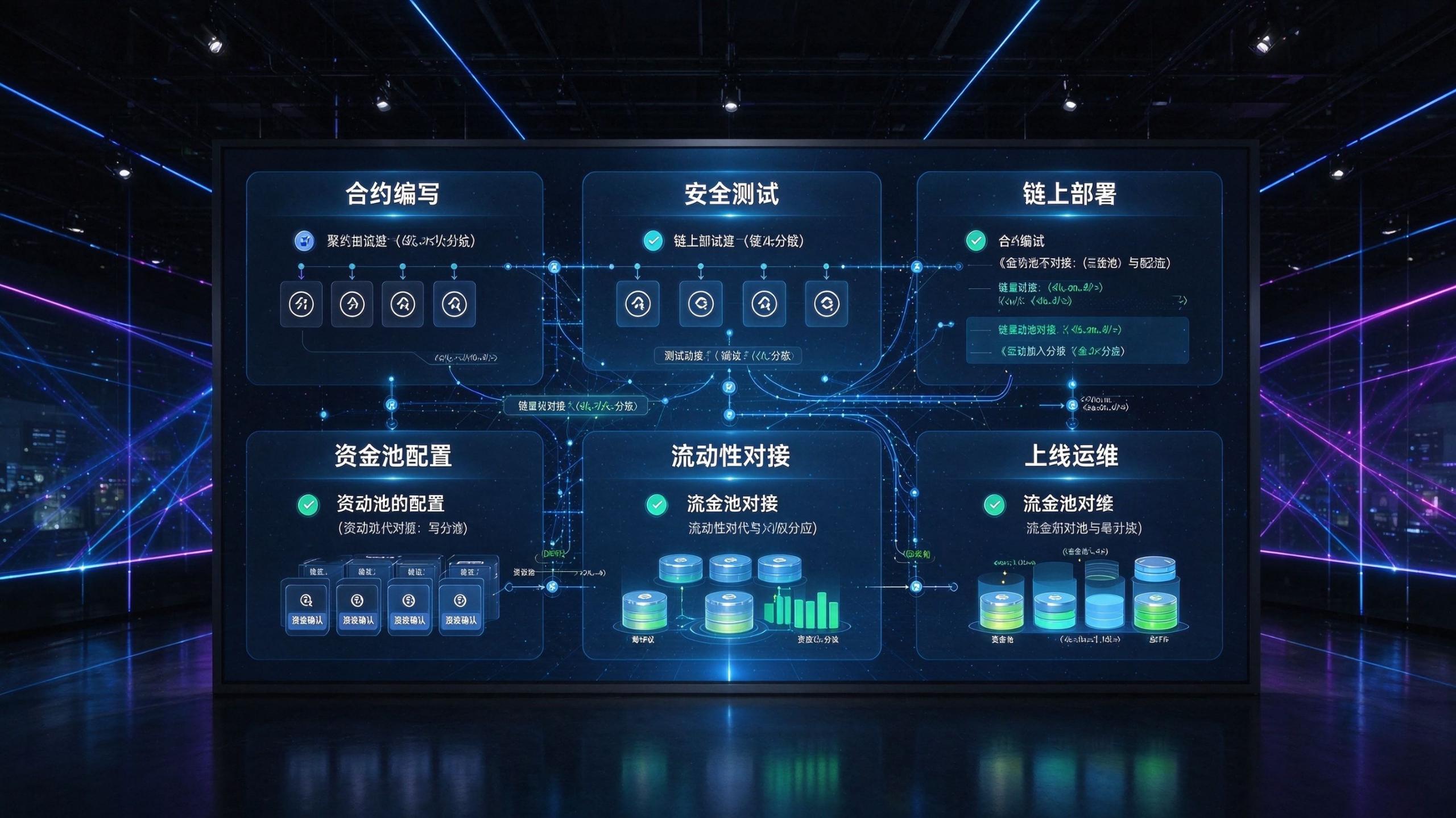
Phase one builds the foundation: complete the DeFi trading and wallet modules, achieve asset ownership and free conversion, and validate the minimal closed loop. Phase two expands capability: launch DeFi lending, stablecoin and yield aggregation products, introduce liquidity incentives, and lift TVL and active addresses to the next level. Phase three opens the boundary: connect cross-chain interoperability and launch leasing, installment, insurance and RWA products so virtual assets can interface with real-world rights. Phase four hands over governance: DeFi parameters and funds gradually transfer to the community, and the team shifts from operator to maintainer.
Every step of this path expands outward with DeFi as its axis, rather than treating DeFi as decorative marketing labeling.
Conclusion: DeFi Determines the Ceiling of the Virtual City
Whether a virtual city can survive cycles depends not on launch-day traffic but on how many people still want to keep their assets inside three years later. What keeps assets there has never been visual fidelity; it is the pricing power, liquidity depth and yield mechanisms that DeFi provides. Metaverse City · High-End Chain Game DeFi Development builds a complete product matrix around DeFi — trading, lending, wealth management, stablecoins, leasing, insurance, cross-chain and wallets — so virtual assets genuinely carry financial attributes, and then connects scenes, assets and users through continuously iterating DeFi protocols and community governance. When DeFi becomes the city's underlying protocol rather than a marketing concept, the metaverse moves from concept demos to a sustainably operating digital economy. Going forward, this DeFi-driven value chain will keep extending, from on-chain finance toward on-chain living.